01
For a few friends · July 2026
A good boring business
Two real projects from the same fortnight, and the company I think they describe.
Justin Lau · scroll, or press ↓
02
The claim
The build was never the product. The change was.
We priced the build because the build was the expensive part.
It isn't any more, and almost nobody has re-priced around that.
03
Why maintenance was always bad
An agency's unit of production is a human hour.
So can you make the logo bigger costs them roughly what it cost in 2010.
Priced honestly, too expensive for a small business. Priced to sell, it loses money — so it gets deprioritised, so the client waits three weeks to fix a phone number, so they stop asking, so the site dies.
Nobody designed that. It falls out of the arithmetic.
04
What they actually want
Not a website. A website that is correct.
Opening hours changed. There's a new person and the old one's photo is still up. There's a closure in August nobody announced.
What kills small-business sites is staleness — and staleness is a service failure, not a design failure.
05
The observation that convinced me
The temple was already on Wix.
Wix is a page builder — the tool invented so non-technical people can keep their own site current. They had it for years. It went stale anyway.
Giving a non-technical organisation a better editor does not make them edit.
They will not learn your interface, however good it is. They want to send someone a photo of a handwritten note and have the website be right afterwards.
06
Case A · a Taoist temple in Hong Kong
Off Wix, rebuilt, and now maintained.
6days from first commit to a client-reviewed rebuild — 115 commits, one person, all agent-written
7rounds of corrections by WhatsApp photograph — six are explicitly evidenced in the repo, the seventh is inferred
4separate batches received, applied, deployed and shown back — inside one working day
Cloudflare Pages, D1, Workers AI, Zero Trust. Hosting cost to date: zero.
07
Case A · the part he praised
Every change, quoted back in his own words.
Each correction returns as a hosted before/after page. His instruction sits beside the change, verbatim — crossings-out and all, never tidied. He reads it on his phone and rules on each line.
The feedback was that the change report is valued alongside the website itself.
That is the single most useful thing either project told me, and it's why I stopped calling this a web business.

One card from round seven. His instruction, then every place on the site it touched — old struck through, new in red.
08
Be honest
Case A is pro bono.
Nobody paid for any of it. So it is worth exactly nothing as evidence about pricing, or whether a stranger would buy this.
It is also family-connected, which weakens the warmest datum in the whole case — that the client praised the change report. Warm engagement with a generous gift from someone you know is ordinary. Treat it as the hypothesis I most want to test on a paying stranger, not as a finding.
It also had an experienced architect doing the work — not the non-technical operator the model depends on.
Read it as proof of tempo, quality, and what clients respond to. Nothing more.
09
Case B · Trent, a marketer in Taipei
No development background. Seven days.
15 July: iterating on a homepage design, hits her plan's usage limit mid-sentence. Has never deployed anything.
22 July: sends me a link to a live HTTPS site on Cloudflare Pages.
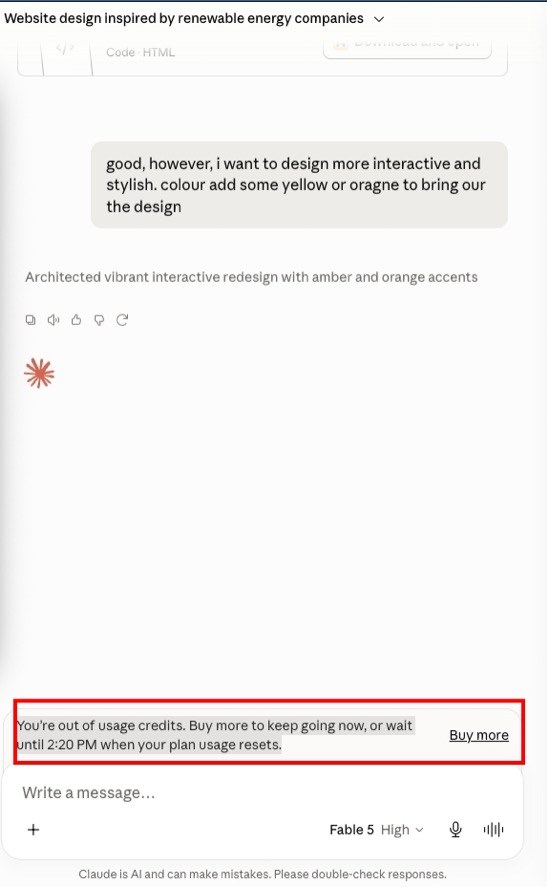
Day one, in her own words — and the banner telling her she'd run out mid-design. Her client's homepage is cropped out of this deck.
10
Case B · the numbers
NTD 150,000 asked for. $25.67 of tokens.
About US$4,640 for the build, at her price, to her client. She told me what she asked for; I have no evidence of what was ultimately paid.
The design cost $25.67 in model spend across three rounds of revision.
I am not claiming that ratio is the business. Her time is the real cost, and it isn't in that number.
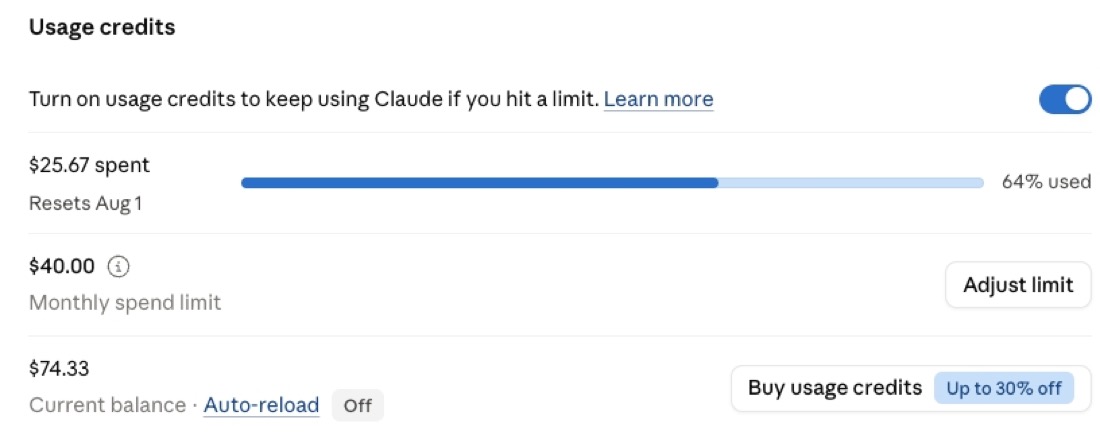
Her spend panel on 21 July.
11
Case B · where the model came from
yeh right, i always bundle with other digital marketing service. like web+SEO
especially those are samll business, just infomation site. low maintanance
Trent · 22 July 2026 · replying to me
Honest caveat: she was agreeing with me — I had just argued that the profit is in the retainer, and her reply opens with "yeh right". What is hers, and what I did not feed her, is the specific shape: bundle it with SEO, and target small information sites. That detail came from her own book of business, and it is the part worth listening to.
Read closely, "low maintanance" is an argument against a maintenance retainer, not for one. See slide 17.
12
Case B · and the honest part
okk i can only understand 30% haha
Trent · 21 July 2026, after I explained CLI harnesses, sub-agents and version control
She's right. And she shouldn't have to understand the other 70%.
Git, deploys, rollback, hosting, access control — none of it is a thing an account manager should be thinking about. That gap is the product I build.
Caveat: she had me on LINE all week. This proves a motivated non-engineer can do it with expert support on tap — which is the proposition — not that anyone can do it alone.
Note the tension with slide 09: she hit a plan limit serving one client. The model assumes one subscription carries fifteen. That number is unmeasured and the only evidence anyone has points down.
13
The company, in two halves
An operator owns the client. I own the machine.
- OperatorA tech-comfortable account manager. Intake, build, revisions, maintenance, upsell. Good at the thing that doesn't automate — judgment about what a client actually meant, and the discipline to check rather than assume.
- Never touchesGit, deploys, DNS, certificates, rollback, infrastructure, cost control.
- I buildDesign skills that produce genuinely good sites. Automated change reports. Cloudflare infrastructure at near-zero marginal cost. Version control and rollback owned by the workflow, not by people.
14
The money · base case
A $250 retainer costs about $26 a month to serve.
$26to serve one client for a month — $16 of it AI, the rest hosting, sundries and card fees
25clients per operator, plus a couple of builds a month
~50%contribution per operator after their revenue share
Every assumption is exposed and adjustable. Open the model →
15
What the margin actually rests on
Cheap tokens are not why this works.
AI is about 6.5% of the retainer. If tokens went to zero tomorrow, the margin moves by 6.5%.
The margin assumption lives in clients-per-operator, not in token prices.
Falling token prices are a cushion against being wrong about everything else. They are not the case.
16
The objection you'll meet most
client insists to have WP :(
Trent · 15 July 2026 · week one
It's almost never a technical preference. It means I don't want to be locked in to you, and I want to be able to hire anyone to take this over. Both reasonable. Neither about software.
- Answer itThe site is plain files in a git repository the client owns. Stronger anti-lock-in than WordPress, where content is trapped in a database and design in a theme.
- Then competeWordPress's promise was never the software — it was someone will keep this current for me, affordably. That used to need a human dispatching work to engineers. Now the grunt work scales indefinitely and the human keeps only the relationship.
- If they insistRun it headless. They keep the admin they asked for, we own the front end. Price it accordingly.
17
The gap
Nobody has ever paid for the retainer.
One case is pro bono. The other is a build fee with no ongoing service attached.
The recurring revenue this entire model rests on has zero months of evidence behind it.
That's not a risk to manage. It's the thing to go and find out.
18
First 90 days
Sell one. Then see if a second person can do it.
- Stage oneOne paying client on a monthly retainer, at a real price, who isn't a friend or a relative. Not three. One — so the number stops being hypothetical.
- AlsoMeasure how many clients one AI subscription really carries. Cheap to test, nobody has, and it's the biggest unknown in the model.
- Stage twoOnly if someone joins: one operator, three clients, ninety days. I stay on call but don't touch the work. The metric is how often they need me, and whether it declines.
- Then decideServices business or tooling business. I genuinely don't know which, and I'd rather find out than guess.
19
The ask
Nothing, immediately.
I'm doing stage one regardless. What would actually help:
- ArgueTell me where this is wrong. The assumptions are exposed so you can drag a slider and show me it doesn't work.
- A clientIf you know a small business with a site that's gone stale — I'll build it and run it for a quarter, and we'll find out what it's worth.
- Or joinYou already own the hard half: the client relationship, and knowing what a client means. I'll handle the part that made you say you only understood 30%.
It's a business where doing the work well is the same thing as winning. No growth hack in it. You answer quickly, you get things right, you show people you understood them, and you keep doing that for years.
Read the full case
Open the model